
How to Prioritize Downtown Projects When Everything Feels Urgent
When Everything Is Important, Nothing Is Clear
By the time a downtown organization hits its stride each year, the to-do list is already long.
Projects carried over from last year. New ideas fueled by early momentum. Board requests. Partner asks. Grant deadlines. Event commitments. Each one feels important because each one touches something real. And urgency builds fast, well before clarity has a chance to catch up.
The result is a pretty familiar pattern. Everything moves forward at once. Staff attention splits. Volunteer energy spreads thin. Nothing fails completely. It just never fully gains traction.
Getting to the other side of that pattern requires one thing more than any other: the ability to separate what feels urgent from what is actually ready.
Urgency Is Not the Same as Priority
Urgency is convincing. Responding fast signals leadership. Visible activity calms nervous boards. Momentum reassures partners.
But urgency is driven by pressure. Priority is driven by judgment. Those are not the same thing.
Urgent projects win attention because they have deadlines, carry emotional weight, or have someone in the room advocating loudly for them. Important work, the kind that actually moves a district forward over time, tends to be slower, less visible, and easy to defer.
When urgency and importance compete, urgency almost always wins. That's not a character flaw. It's just how people work under pressure. Downtown organizations feel it more than most because the work is public, the community is watching, and every delay is visible.
What Happens When Everything Moves at Once
When the work plan tries to advance every priority simultaneously, the damage shows up fast:
Staff attention splits across too many active fronts at once
Volunteer energy spreads thin with no clear place to focus
Decisions get made, then revisited, then made again
Recovery time disappears between efforts
Projects that started strong stall without anyone knowing exactly why
None of this looks like failure from the outside. But inside the organization, everyone's tired and nothing's finished. That's a structure problem, not a people problem. And structure problems have structure solutions.
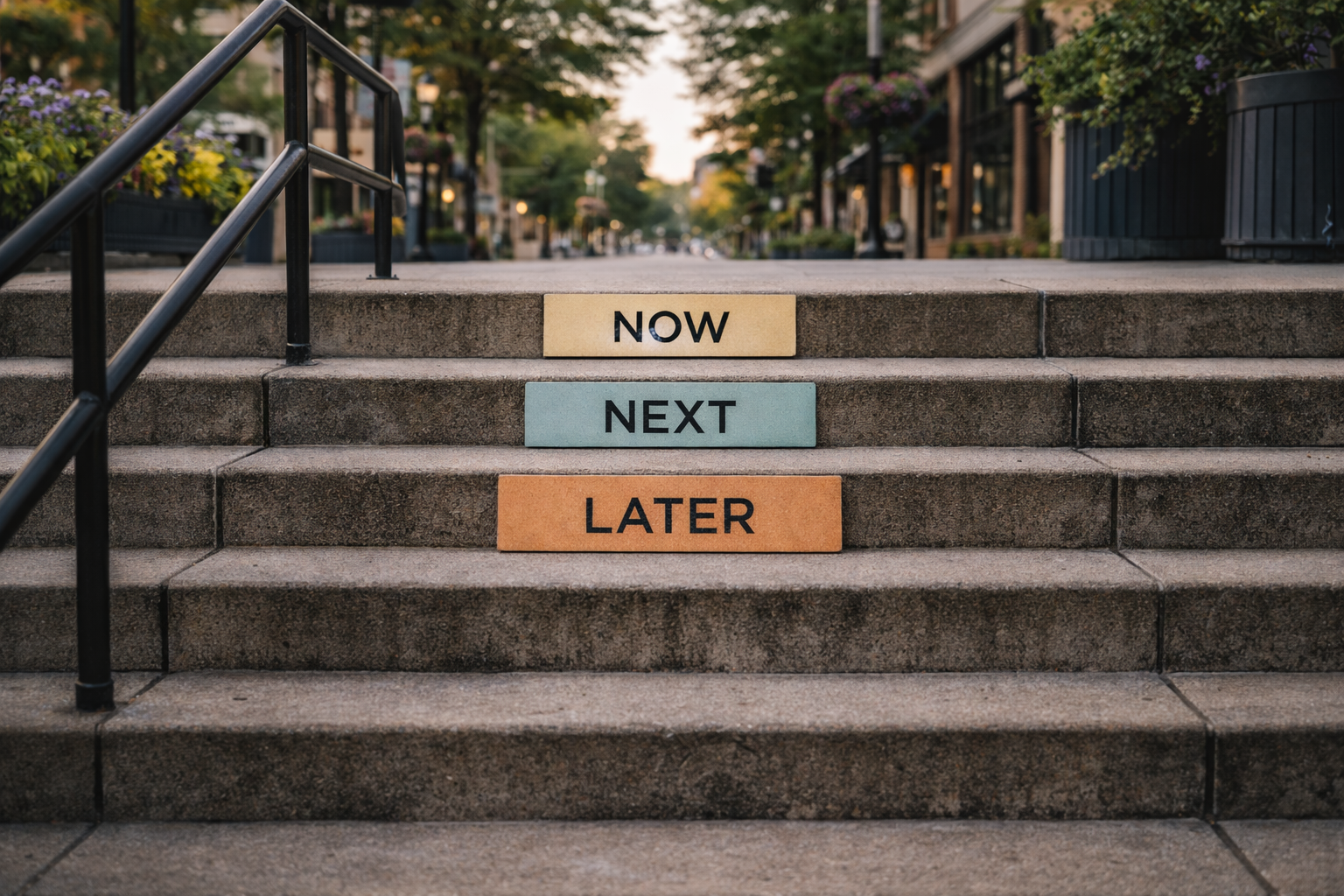
Prioritization Means Sequence, Not Elimination
Here's the misconception that trips most people up: prioritizing does not mean permanently dropping ideas. It means ordering them.
The right question is not "Is this a good idea?" It almost certainly is. The right question is "Is this the right time for this, given where we actually are?"
Sequencing lets good ideas wait until the conditions can support them instead of forcing them into environments that'll strain under the weight. Communities that focus on two or three real transformation strategies consistently produce more visible progress than those trying to advance a list of ten. Focus is not a limitation. It's leverage.
Four Questions That Cut Through the Noise
When the project list feels impossible to sort, start here.
What problem does this actually solve? Projects tied to clearly defined problems produce traction. Projects tied to vague discomfort or general improvement generate activity without impact. If the answer is fuzzy, the project is not ready.
What conditions need to exist for this to work? Think honestly about staff capacity, volunteer availability, partner alignment, and funding. If those conditions are not in place, urgency won't create them. The project will just consume resources and stall.
What else does this compete with? Every initiative competes for time, attention, and recovery. If adding one project quietly undermines another that's already underway, that tradeoff needs to be named before the decision is made. Not six weeks in.
What actually happens if this waits? Sometimes the honest answer is "nothing bad." If waiting improves readiness, that's not delay. That's preparation. Naming that protects the organization from urgency-driven decisions that create more problems than they solve.
Carry-Forward Beats New Starts
Most downtown organizations do an informal reset at the start of each year. Old projects fade. New ideas take the spotlight. The calendar fills up again.
This feels energizing. It's also one of the most reliable ways to lose ground.
Progress compounds when unfinished work gets assessed honestly, lessons carry forward, and partially completed efforts get stabilized before new ones launch. A project that reaches 80% and then gets abandoned isn't a win. It's a drain on credibility, volunteer morale, and the organizational capacity that went into it.
Before anything new goes on the work plan, it's worth asking what actually finished last year, what's close, and what needs to be officially closed out before it quietly keeps consuming resources.
Prioritization Protects Credibility
There's a quieter benefit to getting this right that doesn't get talked about enough: it builds trust.
When a downtown organization commits to fewer things and consistently follows through, something shifts. Partners become more patient because they've seen delivery. Boards become more supportive because the work plan is believable. Staff feel less pressure to overpromise because expectations are grounded in what's real.
Credibility in this work isn't built by having the biggest agenda. It's built through completion. That reputation compounds in ways that are hard to manufacture and easy to lose.
If building that kind of follow-through discipline is something your organization is working on, that's exactly the kind of capacity work RAD does with downtown organizations and EDOs.
Language That Keeps Things Moving Without Overcommitting
One real concern: if leadership starts naming what comes later, people disengage from things that matter to them.
That's a manageable risk. The key is in how it gets said.
There's a big difference between "We're not doing that" and "That's a next-phase project, and here's what has to happen first." The second keeps the idea alive. It signals that leadership has a plan. It preserves enthusiasm without blowing up the sequence.
A few phrases that work:
"This matters, and it comes right after this one wraps."
"We're building toward this, not launching it yet."
"This is on the list for later in the year once we finish what's already moving."
None of these kill momentum. They redirect it toward the work that's actually ready.
The Takeaway
When everything feels urgent, the most responsible move is usually to slow the decision, not the work.
Clear priorities reduce stress, improve follow-through, and produce the kind of progress that's visible and lasting. Downtown revitalization doesn't move forward by doing more. It moves forward by doing what fits, in the right order, with the capacity that actually exists.
That's not a constraint. That's how the work gets done.
Continue the series: Next: Measuring Downtown Success Beyond Foot Traffic
If your project list is out of control and your work plan needs a reset, RAD helps downtown organizations build plans that are actually executable. See our services here.