
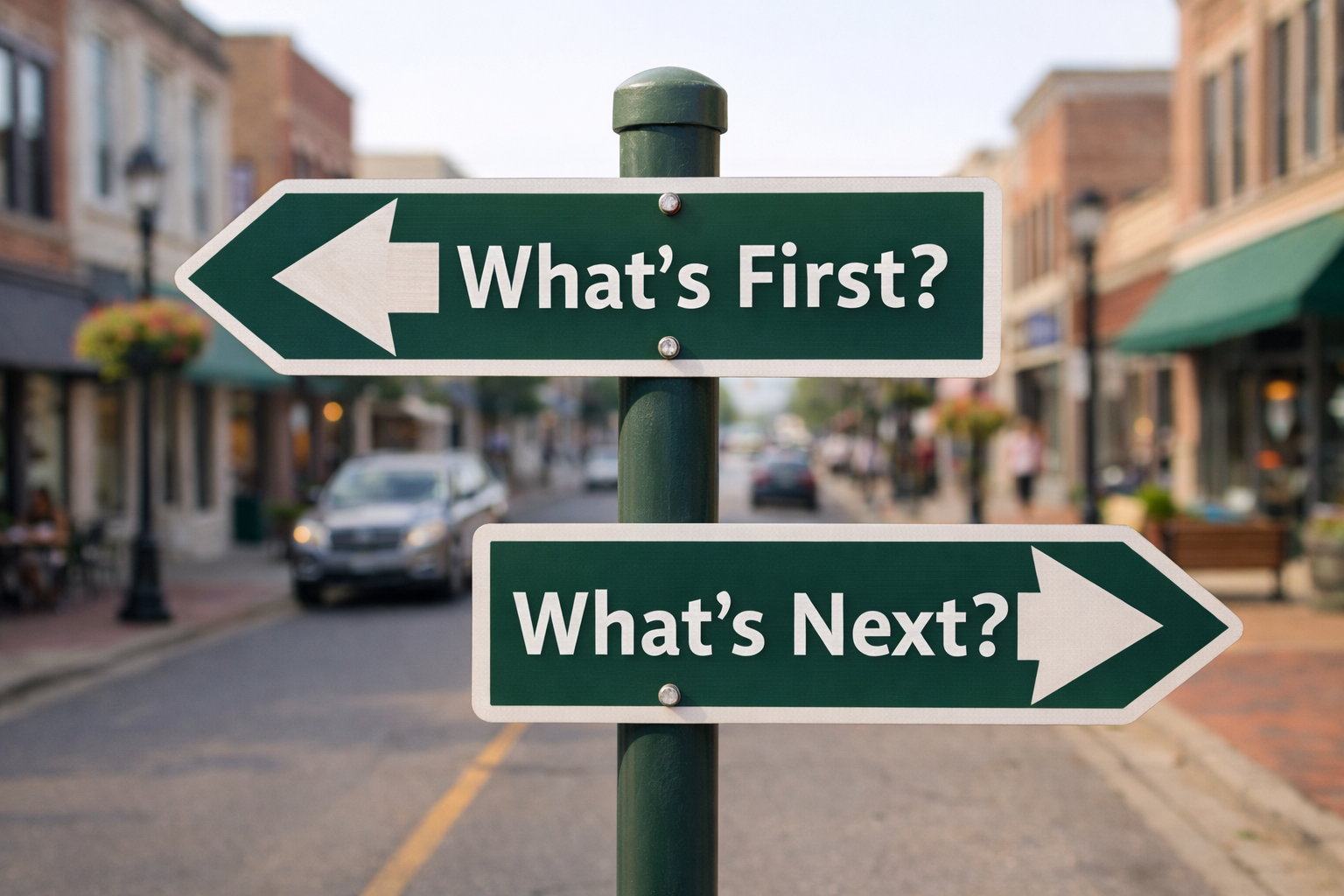
Downtown Revitalization Strategy vs Plan: Why Order Matters More Than Ideas
Planning Is Familiar. Strategy Is Often Missing.
Binders on shelves. PDFs nobody opens anymore. Vision statements printed on foam board in conference rooms. Plans are not the problem.
The problem is that having a plan gets mistaken for having a strategy. Those are two different things, and mixing them up is one of the most common ways good intentions turn into stalled progress.
What a Plan Actually Does
A downtown plan documents ideas, goals, and possibilities. At its best, it creates shared language and signals to the community that the district has direction. It usually includes vision statements, long-term aspirations, maps, recommended projects, and action lists.
Plans are genuinely useful. Do not skip them.
But a plan does not answer the questions that actually determine whether any of it gets done:
What comes first?
What waits?
What stops completely?
What can the organization actually carry right now?
A plan describes where you want to go. It does not decide how you get there, in what order, or what you do when you hit the first obstacle.
That is what strategy does.
What Strategy Does Instead
Strategy is about choice and order. Not creativity, not vision, not enthusiasm. Choice and order.
A downtown revitalization strategy answers a specific set of questions:
What matters most right now, given where we actually are?
What has to be true before the next step will work?
What are we intentionally not doing yet?
How does this year connect to the next one?
Strategy is not a longer, fancier plan. It is the discipline of limiting options so effort can concentrate. Without it, plans keep expanding. With it, plans become something you can actually use.
Main Street America has pointed out that traditional downtown plans tend to outline recommendations without the implementation thinking needed to act on them. That gap between a good plan and a working strategy is where most communities get stuck.
Why Order Matters More Than Ideas
Most downtown plans are full of good ideas. That is almost never the problem.
The problem is sequencing. When multiple initiatives run at the same time without a clear order, several things happen at once: staff time splits in too many directions, volunteer energy spreads thin, coordination breaks down between efforts, and there is no recovery time when something hits a wall.
Nothing fails completely. It just never fully lands.
Getting a few things done in the right order almost always produces more visible progress than doing many things at once. This is where the Strategic Doing framework is useful. Rather than defaulting to a long planning process that produces a document, Strategic Doing asks groups to identify what they can act on right now with the assets they actually have, then build from there in short, accountable cycles.
Order creates leverage. Sequence is strategy in practice.
Signs That Strategy Is Missing
When a downtown organization is running on plan but not strategy, it shows up in recognizable ways:
The same priority debates happen at every board meeting
There is always urgency but rarely traction
Projects start strong and stall before they finish
Nobody is quite sure what progress looks like or how to measure it
Staff and volunteers are tired but the to-do list keeps growing
These are not motivation problems. They are not even planning problems. They are sequencing problems. When leaders do not set the order early, the loudest voices or the most recent grant opportunity sets it for them.
Strategy Is Not the Same as Slowing Down
There is a real fear in downtown work that pausing to clarify strategy will kill momentum. It is understandable. People are ready to move. The community is watching. The grant clock is ticking.
But in practice, skipping strategy almost always costs more time than taking it would have. Rework is expensive. Burnout is expensive. Losing credibility with partners and funders because a project stalled halfway is very expensive.
Clarifying order early is what makes follow-through possible later. It reduces the number of times a decision has to be made twice. It protects the people doing the work. It makes the whole effort more sustainable.
Momentum without direction is just activity.
Strategy Has to Be Grounded in Reality
Here is where a lot of strategy conversations go sideways. They get built on optimism instead of current conditions.
Good strategy starts with an honest read of where things actually stand: the real condition of the downtown, what the organization can genuinely support, what the market will bear, and what the political and community environment looks like right now, not in the ideal scenario.
This is why strategy follows understanding. Not enthusiasm. Understanding.
Before deciding what to do next, a community has to be clear about where it actually is. That is not pessimism. That is how you avoid spending two years on work the district was not ready to support.
Strategy Is a Living Discipline, Not a Document
Downtown strategy is not something you write once and file. Conditions change. Markets shift. Staff capacity fluctuates. Political priorities move. Strategy has to move with them.
Good strategy carries forward what is working, stabilizes what is straining capacity, and lets go of what no longer serves the goal. That is not failure. That is adjustment. It is what separates organizations that compound progress over time from ones that restart every year.
This kind of strategy does not live in a binder. It shows up in how decisions get made, what gets put on the calendar, and what the leadership team is willing to say no to.
Bringing It Back to the Bigger Picture
If downtown revitalization is about strengthening how a district functions over time, strategy is how that strengthening gets paced.
Plans describe the destination. Strategy determines the path, the order, and the speed.
Without strategy, a good plan is just a list of things you hope to eventually get to. With strategy, it becomes a sequence of work that builds on itself.
Order turns intention into progress.
Continue the series: Next: The Most Common Misdiagnosis in Downtown Revitalization
Want to see how RAD works with communities on revitalization, strategy, and capacity? Explore how we help and what we offer.