
Walkability Improvements That Actually Move the Needle
Everyone Supports Walkable Downtowns. Not Every Project Delivers.
Walkability shows up in almost every downtown plan as both a goal and a strategy. It appears in grant applications, public meetings, and board conversations as something close to a universal good. Safer streets, more inviting sidewalks, a better experience for people on foot. It's hard to argue against any of that.
But walkability improvements get oversold regularly, and the communities that invest in them without the right conditions in place often find themselves with attractive streetscapes and not much else to show for it economically.
The goal isn't wrong. The expectation often is.
What Walkability Is Actually Supposed to Do
At its core, walkability reduces friction. It makes it easier to cross the street, understand where to go, stay comfortable for longer, move between businesses, and feel safe doing all of it.
When friction drops, something real happens. People are more likely to linger. They make more trips. Research on pedestrian behavior consistently shows that people on foot make more frequent, more impulsive purchase decisions than people who drove to a destination. A pedestrian who's comfortable and not in a hurry to get back to their car is a fundamentally different customer than one who parked, completed a transaction, and left.
That's the actual value proposition of walkability: not just getting people to show up, but keeping them present long enough for the district to do its job.
Where Walkability Projects Commonly Miss
The gap between walkable-looking and actually walkable is wider than most communities realize going in.
A lot of walkability projects focus on appearance rather than behavior change. Decorative elements get installed without shade or seating that would keep people comfortable. Sidewalks get widened along blocks without businesses or destinations that give people a reason to use them. Design features get celebrated without addressing the crossing safety that was actually keeping people from walking in the first place. And improvements get concentrated on one block and stop abruptly, leaving people to navigate a sharp drop-off in quality right where momentum should be building.
When a walkability improvement doesn't change how people move through the district, it hasn't improved walkability in any meaningful sense. It's improved aesthetics. Those aren't the same thing.
The Improvements That Actually Change Behavior
The projects that genuinely move the needle tend to share a few characteristics that are worth understanding before any proposal goes to a city council or board.
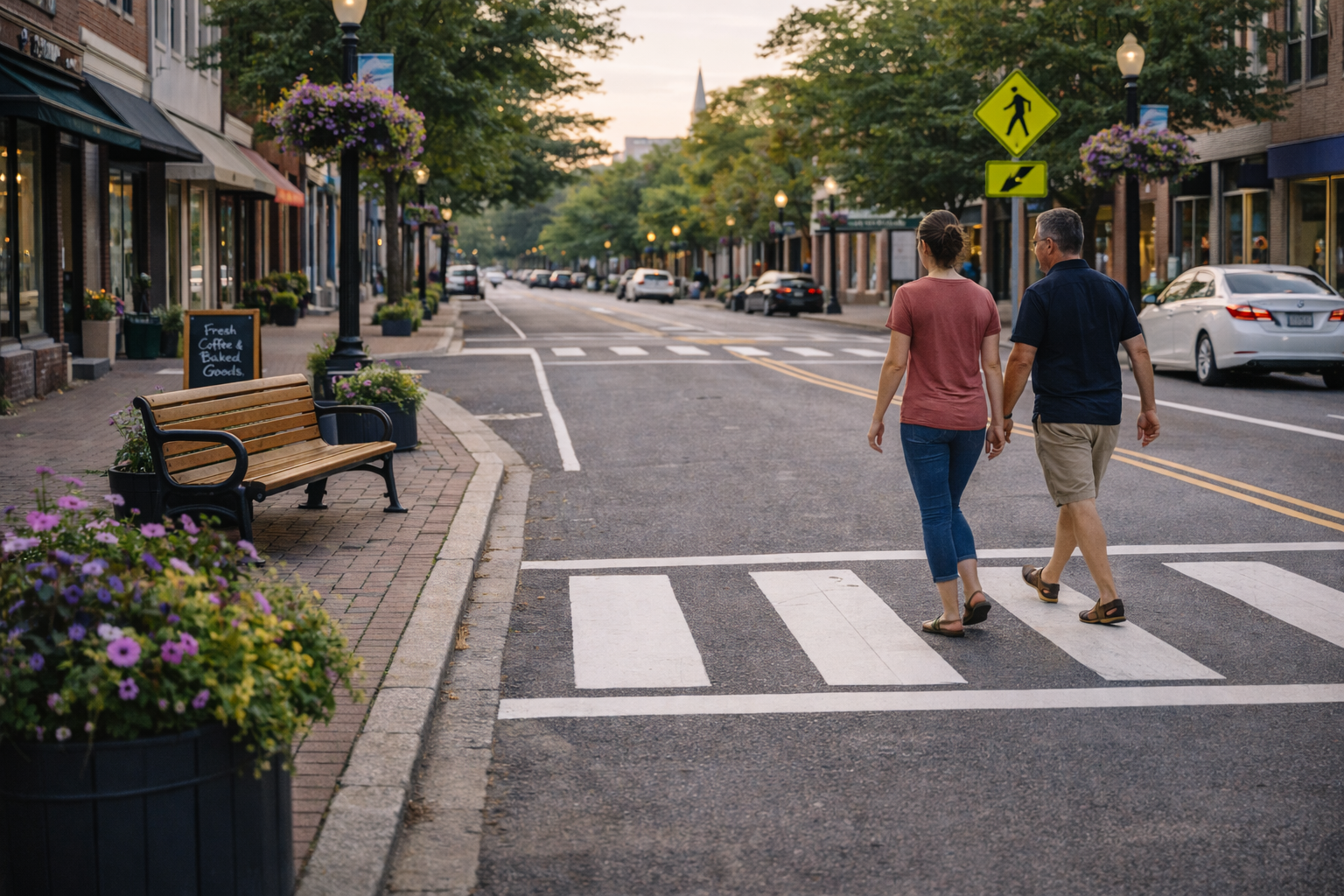
Safe crossings first. People avoid routes where crossing the street feels risky or unpredictable. Shorter crossing distances, better signal timing, curb extensions that improve visibility at intersections, and pedestrian refuge islands on wider roads change behavior faster than almost any other improvement. Crossings often matter more than sidewalks, and they're consistently underinvested relative to the surface treatments that get the most attention.
Comfort over appearance. Shade, seating, lighting, and physical separation from moving traffic determine how long people stay, not just whether they pass through. A wide sidewalk with no place to sit and no shade on a summer afternoon is a wide sidewalk people walk through as quickly as possible. Comfort is what converts a passing pedestrian into someone who stops.
Navigation that's obvious. Confusion kills momentum faster than most physical barriers. People need to understand where downtown begins, what's nearby, and how to get between things without guessing. Simple, well-placed cues often outperform elaborate and expensive wayfinding systems. A clear sense of orientation is more valuable than a branded map kiosk.
Connection between things people already do. The most effective walkability improvements stitch together activity that already exists. Connections between parking and active storefronts, between anchor destinations and side streets, between residential density and business clusters. Improvements placed in isolation, where there's no existing movement to enhance, tend to perform poorly regardless of how well-designed they are.
Design vs. Use: The Real Tradeoff
Design-driven projects look impressive. That's worth saying plainly, because looking impressive generates political support and makes for good grant documentation.
But looking impressive and changing daily behavior are two very different outcomes. A project that alters how people actually move through the district, even modestly, produces more economic return than one that photographs well and gets used the same way the space was used before.
The discipline required here is choosing fewer improvements that actually change patterns over a longer list of features that make the space look better without changing what people do in it. That's a harder case to make to a board or a city council. It's also the case that produces durable results.
Walkability Doesn't Create Vitality From Nothing
This is the part that gets left out of most walkability conversations, and it's important enough to be direct about.
Walkability supports activity. It doesn't generate it from conditions that aren't there.
If businesses have inconsistent or limited hours, if the mix of uses isn't drawing people for daily needs, if destinations are unclear or scattered, walkability improvements will struggle to produce economic return no matter how well executed they are. The physical improvements are working against a system that isn't ready to take advantage of them.
That doesn't mean walkability projects are wasted under those conditions. It means they need to be sequenced correctly relative to business stabilization and organizational capacity. A beautiful streetscape on a block of vacant storefronts is a maintenance cost, not an economic development investment.
Timing Matters More Than Scale
Small improvements introduced at the right time in the right location regularly outperform large projects that arrive too early.
Walkability investments work best when business retention is improving and there's something worth walking to, when storefronts are active or at least activating, when the organization has the capacity to maintain improvements over time, and when there's enough pedestrian movement already present that an improvement has something to amplify.
When those conditions aren't in place, even well-funded, well-designed projects tend to add maintenance responsibility without delivering proportional benefit to the businesses that were supposed to benefit from them.
Questions Worth Asking Before Any Project Gets Approved
Before a walkability project moves into design or funding pursuit, these questions are worth sitting with honestly.
What specific behavior will this change, and how do we know?
Who will actually use this improvement on a regular day, not a festival day?
What friction does it remove that's currently keeping people from walking more?
How will we know whether it worked, and on what timeline?
If the answers are vague, the project probably needs more definition before it advances. That's not a reason to abandon it. It's a reason to slow down long enough to make it worth doing.
The Takeaway
Walkability improvements matter most when they change how people move and feel downtown on an ordinary day, not just when something special is happening.
Projects that shorten crossing distances, increase comfort, and connect existing activity tend to deliver lasting value. They're often less flashy than the alternatives. They're also consistently more effective.
The most disciplined walkability investments are the ones that start from behavior, not from design. And the most important timing decision is whether the district is ready to benefit from what's being proposed.
Continue the series: Next: Downtown Business Mix: What to Recruit (and What Not to Recruit)
RAD works with municipalities, Main Street programs, and organizations working to improve their downtowns. Explore our services and see how we help here.