
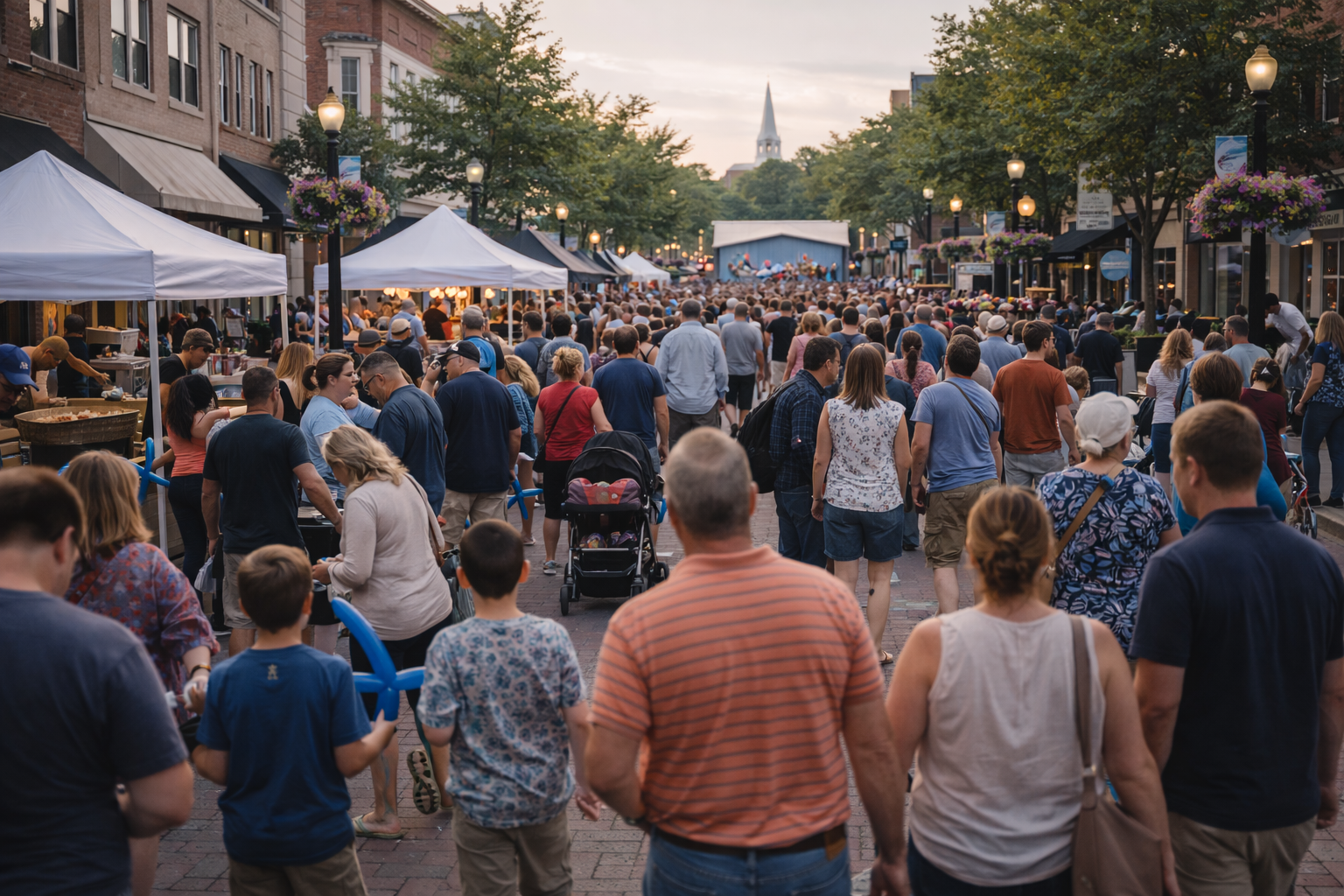
The Truth About Events as a Downtown Strategy
Events Are Not the Problem. Over-Reliance on Them Is.
Events are one of the most instinctive tools in downtown revitalization. They're visible, they're energizing, and they're easy to rally around. A good event brings people together, generates community pride, and creates a moment that reminds everyone why downtown matters.
For a lot of communities, events are also the first signal that something is being done. That makes them appealing well beyond their actual strategic value.
The honest truth is that events are frequently asked to do work they were never designed to do. And when that happens, they consume capacity without delivering the kind of progress the district actually needs.
Why Events Become the Default
Events feel productive in ways that most downtown work doesn't.
They produce crowds and photos. They have clear timelines and visible outputs. They're easy to explain to boards, funders, and elected officials who want to see momentum. They fit naturally within short-term funding cycles and the kind of volunteer enthusiasm that spikes at the beginning of a year.
When progress feels slow or the district feels quiet, events offer reassurance that something is happening. And that reassurance is genuinely valuable, up to a point.
The problem shows up when events shift from being a tool to being the strategy. When the event calendar becomes the work plan. When the district's sense of progress is measured by how busy it looks on its best weekends rather than how well it functions the rest of the time.
What Events Actually Do Well
Used intentionally, events have real value. It's important to say that clearly before getting into the limitations.
Events introduce people to downtown who might not otherwise come. They create shared experiences that build community attachment. They test programming concepts before anyone commits to something permanent. They give existing businesses a revenue boost during what would otherwise be slow periods. And they generate the kind of visible energy that helps communicate to the broader community that downtown is alive and worth paying attention to.
They're especially effective at visibility, celebration, and creating moments of connection. Those things matter. A community that feels proud of its downtown is a community more likely to support it.
Events are good at generating spikes. The question is always what happens between them.
What Events Can't Do
Events don't stabilize businesses. A great festival weekend doesn't help a struggling retailer make rent on the other 51 weekends of the year. Events don't reduce operating costs, solve vacancy, replace predictable daily foot traffic, or build the organizational capacity needed to carry the work forward.
When events are expected to do those things, which happens constantly in downtown work, expectations outpace results almost immediately. The district can look busy without becoming more resilient. And the people inside the organization, the ones actually running the events, start to feel the gap between how things look on a Saturday and how they actually are on a Tuesday.
That gap is one of the clearest signals that events have outgrown their role.
The Real Tradeoff: Visibility vs. Reliability
Downtown health depends on reliability. Events maximize visibility. Those two things pull in different directions when resources are limited, which they almost always are.
The tradeoff becomes clearest when resources that should be going toward retention, organizational development, and business support are flowing disproportionately into event production. When staff and volunteers are consumed by logistics, set-up, and breakdown cycles. When core work gets delayed because there's another event coming up. When businesses report that event-driven surges are actually hard to manage because they create operational spikes the business can't staff for consistently.
Reliability comes from consistency. Consistency comes from the unglamorous work that events tend to crowd out.
When Events Actually Support the Strategy
There's a version of this where events work well and add real value. It's not complicated to describe.
Events support downtown strategy when businesses are already stable enough to absorb the increased traffic. When hours are consistent enough that people who come for an event can actually visit the businesses they're supposed to be supporting. When the organizational capacity is in place to run events without burning through the people who are also supposed to be doing everything else. And when the events themselves are designed intentionally around what existing businesses need rather than around what looks impressive from the outside.
In those conditions, events reinforce patterns that are already working. They amplify function. They don't compensate for its absence.
When Events Start Working Against Progress
Events become a liability when they replace retention efforts that should be happening. When they mask vacancy and churn by making the district look full on event days. When the pressure to maintain novelty and scale pushes every new event to be bigger than the last. When limited capacity gets consumed by production rather than by the work that actually builds the district's long-term health.
The pattern tends to develop gradually and then feel sudden. One year the event calendar is a tool. A few years later it's the identity of the organization. The board measures success in attendance numbers. The staff measures their year in events produced. And the daily work of business support, assessment, sequencing, and capacity building has been quietly squeezed out.
When a downtown needs an event to feel successful, that's worth examining honestly.
The Hidden Cost of a Packed Calendar
As event calendars grow, so does everything required to support them. Volunteer coordination gets more complex. Logistics get more expensive. Community expectations for quality and scale ratchet up, and they rarely ratchet back down.
The result is a version of the same dynamic that shows up in organizational overcommitment everywhere: the work required to maintain the program grows faster than the benefit it delivers. Staff roles drift toward event production and away from the strategic work the organization was built to do. Burnout follows, quietly at first.
This isn't a failure of events as a concept. It's a capacity mismatch between what the calendar demands and what the organization can actually sustain.
A Better Way to Evaluate Every Event on the Calendar
Before any event gets added, expanded, or continued on tradition alone, these questions are worth answering honestly.
Who does this primarily serve, and is that who the downtown needs to be serving right now?
Which existing businesses actually benefit, and how can we measure that?
What does this event require in terms of staff time, volunteer hours, and organizational capacity?
What doesn't get done because this event is on the calendar?
How does this specific event support the daily use of downtown, not just occasional traffic?
If the answers are vague, the event is probably more symbolic than strategic. Symbolic value has a place. It just shouldn't have the same budget and staff time as work that actually builds the district.
Events as Multipliers, Not Foundations
The clearest way to think about where events belong in the sequence: they're multipliers. They work when there's something worth multiplying.
Events work best when they follow a period of stabilization, when the district has an identity clear enough to reinforce, when they can test new ideas at a scale the organization can support, and when they're explicitly connected to business retention rather than separate from it.
They work poorly when they're used to jump ahead in the sequence. When a district that isn't yet stable tries to use events to create the impression of stability. That impression is fragile, requires constant maintenance, and doesn't compound the way real function does.
The Takeaway
Events are not the problem. Over-reliance on them is.
Downtowns that use events thoughtfully, sparingly, and in the right sequence tend to see them add genuine value. Downtowns that lean on them as a primary strategy tend to stay visible without becoming durable.
The most effective downtown organizations let events support the work. They don't let events replace it.
Continue the series: Next: 7 Steps to Rebuilding Downtown
RAD works with municipalities, Main Street programs, and organizations working to improve their downtowns. Explore our services and see how we help here.