Downtown Developer Recruiting: What Communities Get Wrong
"We Just Need to Find a Developer" Is Usually the Wrong Starting Point
When downtown projects stall, the conversation tends to arrive at the same place.
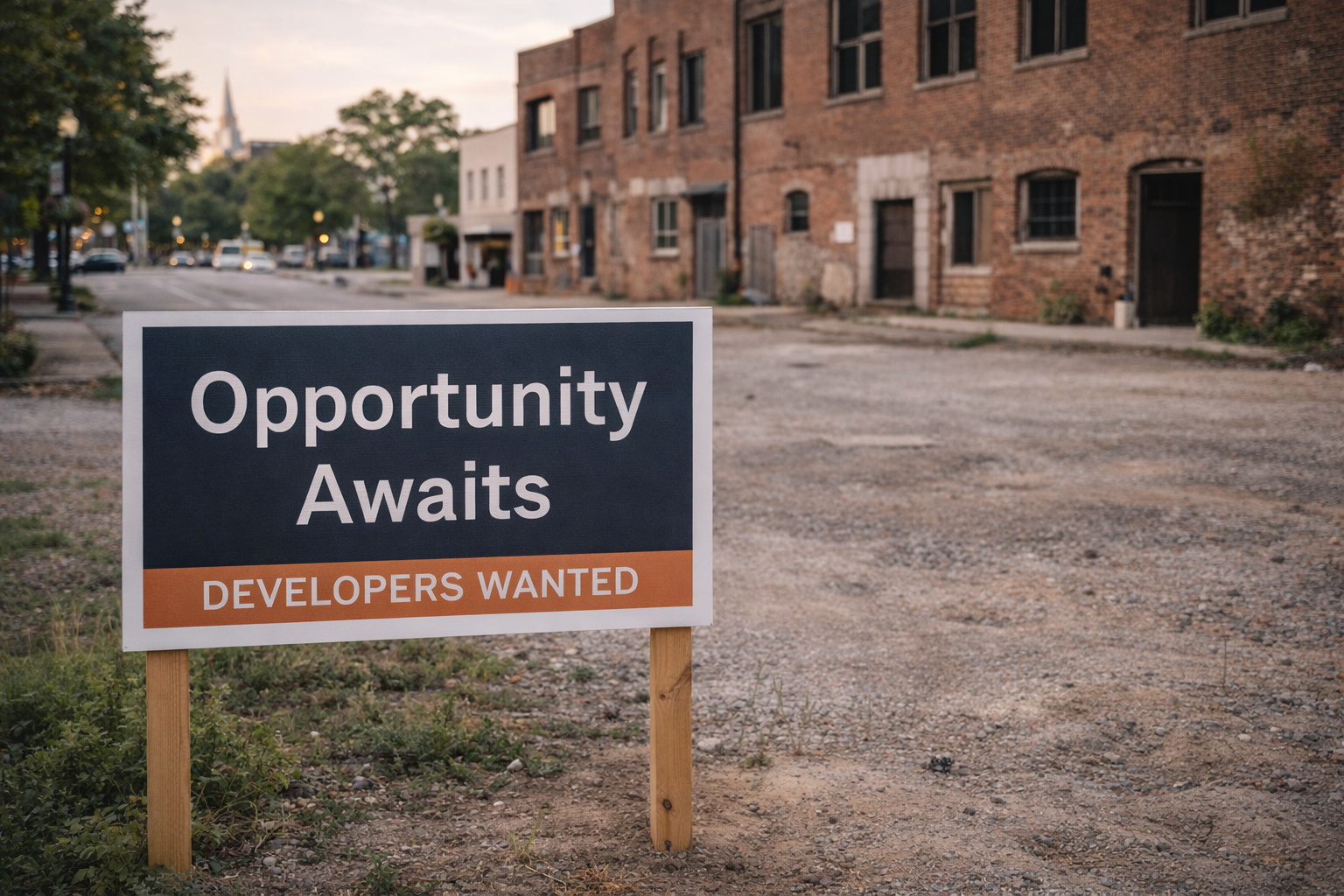
"We just need to attract a developer."
It's an understandable conclusion. Developers bring capital, experience, and the ability to actually get something built. When a building has been sitting empty for years, or when a corner lot has been a sore subject at every board meeting, developer recruiting feels like the move that unlocks everything else.
But in most communities, the problem isn't that developers aren't interested. The problem is that communities aren't ready for them. And those are two very different problems with very different solutions.
Why It Gets Framed Wrong From the Start
Developer recruiting tends to get approached like business recruitment. Build a pitch. Highlight the incentives. Show off the opportunity. Cast a wide net and see who responds.
That approach works reasonably well for attracting businesses. It doesn't translate well to real estate development, and here's why: developers don't lack ideas. They lack certainty. A business owner deciding where to open a shop is weighing a relatively short-term commitment. A developer taking on a downtown project is committing years of work, significant capital, and significant risk to an outcome that depends on conditions they can't fully control.
What they're scanning for isn't enthusiasm. It's clarity. They want to know whether the numbers can work, how long approvals will take, who actually controls the site, what conditions are negotiable, and whether the community's expectations are grounded in reality. Communities that can answer those questions clearly are far more attractive than communities with a great pitch and fuzzy answers.
The Misread Most Communities Make
When developers don't bite, the typical explanation goes one of a few directions.
The market is too small. The incentives aren't generous enough. The location doesn't have enough visibility. The community doesn't have the right connections.
Those explanations feel logical. They're also usually wrong.
Developers walk away from downtown opportunities more often because the project isn't financially feasible as presented, because the entitlement and approval process is unpredictable enough to make the timeline unmanageable, because the building's actual condition is worse than what was communicated, or because the timeline required to close a deal stretches beyond what any reasonable investor can absorb.
The issue isn't that the community failed to sell hard enough. It's that the opportunity wasn't ready to be sold.
What "Ready" Actually Means
Communities frequently market sites and buildings as ready for development when they're not even close. And developers know this quickly. They've seen it before.
True readiness means clear ownership and actual control of the site, known building conditions documented with real numbers, realistic use scenarios grounded in what the local market can support, zoning and code clarity that doesn't require a developer to gamble on an approval process, and genuine alignment among the decision-makers who would need to say yes for a project to move forward.
When any of those elements are unresolved, a developer who decides to pursue the project ends up spending their own time and money diagnosing problems the community assumed were already solved. That's expensive. Many developers don't wait to find out just how expensive. They move on to a market where the groundwork has been done.
Incentives Are Not the Lever Most Communities Think They Are
Incentives show up early in almost every developer recruiting conversation, usually as the primary tool. More incentives, better incentives, creative incentives.
Incentives do matter. They're just rarely the deciding factor when the fundamentals aren't in place.
Incentives work best when the base deal is already close to feasible, when the financing gap is clearly defined and the incentive genuinely closes it, and when everyone involved has aligned expectations going in. In that context, the right incentive can tip a deal from possible to done.
When incentives are being used to compensate for unclear fundamentals, they add complexity without adding certainty. And developers, especially experienced ones, will tell you they'd take fewer incentives they can count on over a longer list of conditional or speculative ones. Predictability beats generosity almost every time.
Over-Promising Kills More Deals Than Under-Incentivizing
This one is worth saying directly because it tends to get overlooked.
When communities are eager to attract a developer, there's a pull toward presenting the opportunity in its best possible light. Renovation costs get underestimated. Demand gets overstated. Approval timelines get described more optimistically than they've ever actually moved. Flexibility gets implied that the system doesn't actually allow.
This backfires reliably. Developers are doing their own due diligence. When what they find doesn't match what they were told, even on smaller details, it signals that deeper misalignment is likely. Trust erodes fast in real estate because the stakes of being misled are so high.
Honest communities that clearly name what they don't know, what the real challenges are, and where the gaps in a deal exist tend to have better developer relationships than communities that oversell. A developer who goes in with accurate expectations is far more likely to close than one who feels like they're discovering problems on the way to the table.
Fewer, Better Conversations Beat More Leads
The volume-of-leads approach to developer recruiting feels productive. It usually isn't.
The developers most likely to succeed in a small or mid-sized downtown are the ones whose business model actually fits that scale and market type. Large regional or national developers often have minimum project sizes, return expectations, or deal structures that don't work in a community of 15,000 people with a 30,000 square foot opportunity. Pursuing them anyway wastes time on both sides.
Better developer recruiting means identifying who actually does this kind of work at this scale in markets like yours, having fewer and more informed conversations with those people, presenting opportunities with the kind of clarity and honesty that builds trust, and respecting that developers' time is a scarce resource they won't keep spending on communities that aren't ready.
A developer who passes this year because conditions aren't right but leaves with a clear picture of what's being worked on is far more valuable than ten developers who came for a site tour and never followed up.
What Downtown Organizations Can Actually Do
Downtown organizations aren't developers. They shouldn't be trying to act like developers. But they play a critical supporting role in making developer conversations more productive.
That means helping package realistic opportunity profiles that lead with what's actually true rather than what's aspirational. It means coordinating conversations across city departments so a developer isn't getting different answers from different offices. It means setting honest public expectations about timelines so that community pressure doesn't create urgency a project can't absorb. And it means supporting property owners through early feasibility work so that buildings are actually closer to ready before a developer ever gets called.
The value a downtown organization brings to developer recruiting isn't salesmanship. It's reduction of uncertainty. That's what developers are actually paying attention to.
This Connects Directly to Assessment and Feasibility
Developer recruiting failures almost always trace back to earlier steps that were skipped.
When a building's feasibility hasn't been honestly tested, when market demand is based on hope rather than data, and when ownership expectations haven't been aligned with development realities, recruiting a developer just surfaces all of those issues later in the process, at a much higher cost to everyone involved.
Developer recruiting works best after an honest assessment has been completed, not as a substitute for doing one. The communities that attract and retain development partners are the ones that did the preparation work before they made the call.
The Takeaway
Downtowns don't attract developers by trying harder. They attract developers by being clearer.
When communities focus on genuine readiness, honest feasibility, and realistic expectations, the right developers tend to find them. Developer recruiting isn't a persuasion challenge. It's a preparation challenge. And preparation is work that any community can do.
Continue the series: Next: Place Branding vs. Marketing
RAD works with municipalities, Main Street programs, and organizations working to improve their downtowns. Explore our services and see how we help here.