Case Study
From a General Vacancy Problem to a Property Action Pipeline
Client: City of Arcola, Illinois
Engagement: Vacancy to Vibrancy Downtown Property Action Strategy
Timeline: Summer 2026
Momentum Condition: Investment without building readiness
The Context
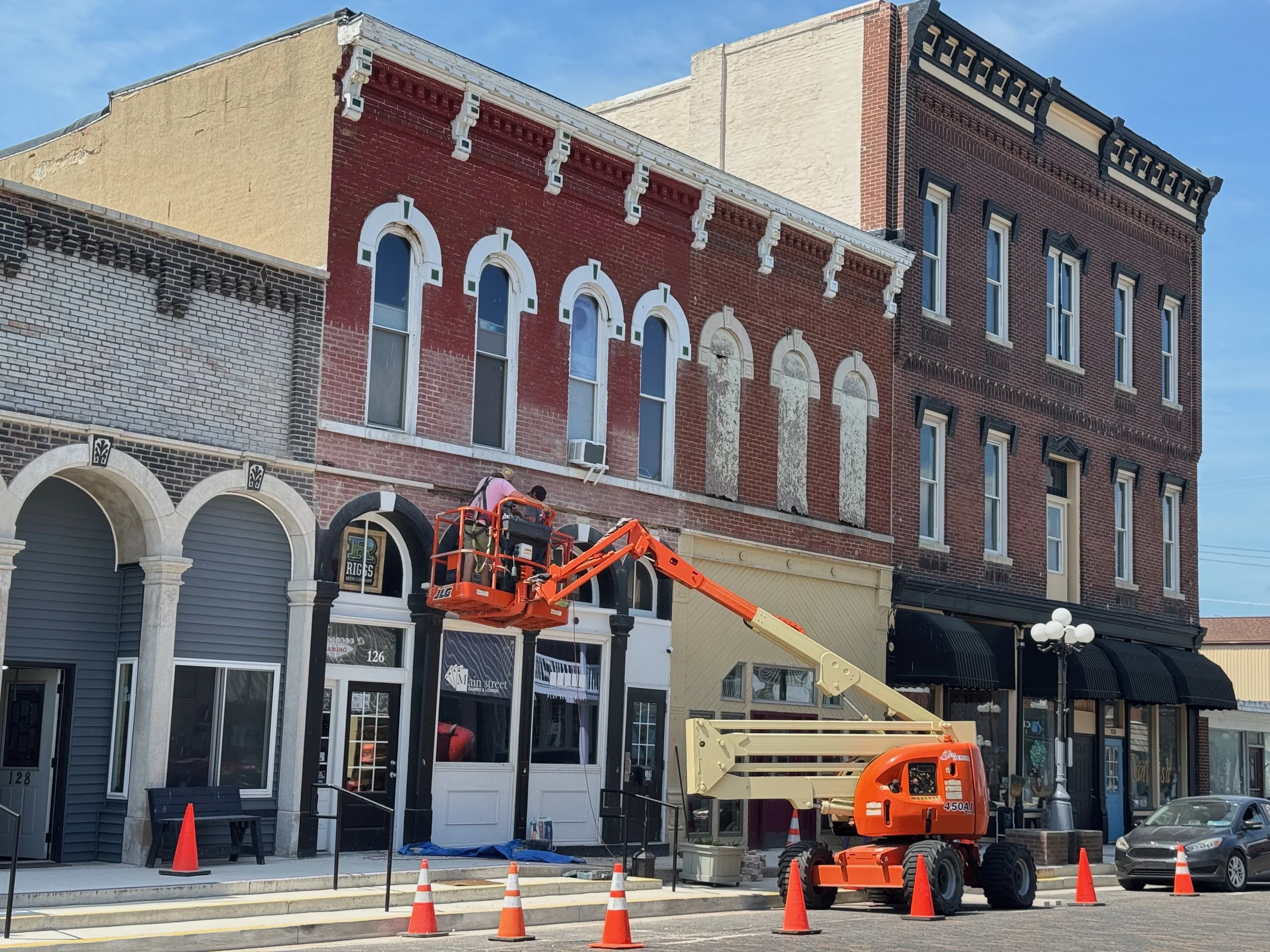
Downtown Arcola is a compact historic commercial district with brick streets, established businesses, community destinations, and years of public investment behind it.
The City had already done a lot of work downtown. It had invested in public improvements, used Tax Increment Financing and Business Development District resources, supported private rehabilitation projects, run a storefront improvement program, and helped build local entrepreneurial capacity. Earlier planning had set priorities for preserving the district's character while strengthening its business environment.
Several prominent storefronts still sat vacant or underused, and the City wanted to understand why.
The Challenge
Vacancy can make a downtown problem look simpler than it is. One empty storefront may just need a tenant. Another may need a new roof before a tenant is realistic. A third may have a willing owner without a workable project scope, and a fourth may be stalled because the owner has little reason to reinvest. Arcola had examples of each.
The City engaged Reader Area Development to inventory downtown buildings, identify a short list of properties with realistic paths forward, and build an action pipeline staff could use with owners, developers, and funding partners. The work was grounded in fieldwork, with time spent on the street and inside buildings.
As the assessment progressed, the underlying issue came into focus. Arcola had a building readiness problem tied to ownership and implementation problems. Some vacant buildings were fundamentally stable. Others needed substantial reinvestment before anyone could use them. A large share of the vacancy was also held by a small number of ownership groups.
The City needed more than a vacancy count. It needed a way to decide:
Which buildings need attention first
Which can move toward occupancy sooner
Where stabilization has to come before redevelopment
When incentives are appropriate
When an ownership transition might produce a better outcome
What the City should expect in return for public investment
How staff and Council can track progress over time
The Work
RAD completed a building-by-building assessment of the downtown core between June and August 2026. The engagement included:
Field documentation of occupancy, ownership, physical condition, and visible deferred maintenance for downtown commercial properties
Review of available ownership and transaction records
Interior tours where owners provided access
Meetings with City staff and conversations with building and business owners
Stakeholder working sessions, including a Main Street Monopoly exercise that asked participants to allocate limited hypothetical resources among vacant and underused properties
Review of existing TIF and Business Development District programs and commitments
Evaluation of rehabilitation, stabilization, acquisition, and ownership-transition options
Action plans for individual priority properties, a 24-month implementation pipeline, and measurable performance targets
The inventory covered 36 downtown properties. Each was evaluated through a four-part condition framework, so vacancy alone didn't make a building a priority. That separated stable, productive buildings from those needing reinvestment, stabilization, or immediate attention, and it shaped everything that followed.
Download > > > Vacancy to Vibrancy Downtown Property Action Strategy
What the Fieldwork Found
Downtown Arcola was in better overall condition than its storefront vacancies suggested. Most properties were occupied, maintained, or reusable. The serious problems were concentrated.
Six properties fell into the two most serious categories, C | Stabilization Needed and D | At Risk. RAD identified five properties for focused action over the next 24 months. Their barriers varied: some needed professional assessment or stabilization, while others depended on project execution, phased rehabilitation, or an ownership change. Three other vacant properties were stable enough to treat as near-term Ready for Reuse opportunities.
That finding changed the strategy. Arcola didn't need the same intensive intervention on every vacant building. It could run several tracks at once: move stable space toward tenants, stabilize deteriorating buildings, and pursue negotiated investment, ownership transition, or selective site control where ownership was the obstacle.
Incentives and Accountability
Arcola already had redevelopment tools. Its TIF Storefront Façade Program provides a 1:1 private match with a maximum $20,000 grant for eligible exterior work, and TIF agreements can support broader costs including rehabilitation, acquisition, site preparation, professional services, and infrastructure.
Those tools needed clearer lanes. A façade grant helps a sound building improve its storefront. It does little for a building with a failing roof, masonry deterioration, structural questions, obsolete systems, or a rehabilitation budget many times larger than a $20,000 match.
RAD recommended keeping the storefront program and adding a Downtown Building Stabilization & Reuse Program for larger projects. The strategy also recommended reconciling existing TIF and BDD commitments before setting new funding levels. Stalled projects should move forward, be amended to reflect current conditions, or be formally closed so public money isn't tied up indefinitely.
Going forward, public investment should be attached to a defined project, with a scope of work, private participation, a schedule, professional review where needed, verified completion, and measurable results.
Money alone won't resolve every property. Some owners were already moving projects forward. Others faced cost, technical, or capacity barriers. A few buildings had been inactive or deteriorating long enough to require a different conversation. The strategy paired assistance with property standards and enforcement:
Clear expectations for properties receiving public assistance
A review of the City's existing authority to address serious maintenance conditions
Enforcement coordinated with real financial and technical assistance
Professional assessments where building conditions remain uncertain
Support for ownership transition where reinvestment is unlikely under current ownership
Selective or interim site control where it offers a realistic path to stabilization and reuse
Owners ready to reinvest get a clearer path to assistance. Buildings that keep deteriorating get a clear path toward action.
The Outcome
The Vacancy to Vibrancy Downtown Property Action Strategy was presented to the Arcola City Council in September 2026. It gives the City a system for managing individual properties through a 24-month pipeline in three stages.
0 to 6 Months | Define and Advance
Confirm the next action for each priority property, complete professional assessments where needed, reconcile open TIF commitments, establish the stabilization and reuse program, and identify properties that need formal maintenance follow-up.
6 to 12 Months | Commit and Construct
Move projects with workable scopes into stabilization or rehabilitation, advance ownership transitions where appropriate, and carry larger projects through redevelopment agreements with milestone tracking.
12 to 24 Months | Reuse and Reset
Move stabilized properties toward occupancy or their next redevelopment phase, reassess building conditions, continue enforcement where serious issues remain, and begin shifting successful tools toward the BDD, a successor TIF, or other funding sources.
24-month targets
Move 2 to 3 priority properties into active rehabilitation, stabilization, or ownership transition
Reduce the six properties classified C | Stabilization Needed or D | At Risk
Return at least two vacant spaces to productive use
Tie 100% of new City-assisted projects to defined scopes, timelines, and completion requirements
Review priority properties and existing redevelopment commitments quarterly
Implementation is just starting. What the City has now is an accurate picture of downtown's buildings and a specific next step for each priority property.
Why It Matters
Downtown vacancy is rarely a simple leasing problem. A community can recruit entrepreneurs, market available space, host events, and offer incentives and still struggle to fill storefronts if the buildings aren't ready for investment.
The work starts with building-level questions. Which spaces are ready now? Which need stabilization? Which owners can move? Where does rehabilitation not pencil out? Where can public dollars change the outcome, and where should the City expect more in return?
Answering those questions property by property lets Arcola concentrate limited staff time and redevelopment funding where it will produce results. A few buildings moving in the right direction can change the trajectory of an entire block.
Is Your Downtown Facing Similar Challenges?
Many communities already have incentives, entrepreneurs, public improvements, and local support while a handful of difficult properties hold everything back. Reader Area Development helps communities turn broad concerns about vacancy and deterioration into building-level priorities, realistic redevelopment tools, and an implementation pipeline local leaders can manage.
Check your Downtown Momentum Score and book an appointment today.